Allergen Management

Product, Process and Site Allergen Management

Last updated: 15/Oct/2026Download this page (PDF)Share this: fXin✉
In this guide
This guide breaks the subject down across the eight Food Safety & Quality system elements below — Development, Documentation, Implementation, Monitoring, Corrective & Preventative Action, Verification, Validation and Training. Select any element to explore detailed, best-practice guidance.

Premium Resources

Download our Premium Allergen Management Resources

LOAD ALL

Downloading a resource will add this resource to your resource subscriptions. You will be notified of future updates to this resource via email (you may unsubscribe at any time by clicking the unsubscribe link in the email notification, or to unsubscribe immediately from all update notifications, click here)

To define detail, scope and purpose.

Development

This information can be used to develop food safety and quality programs that meet the requirements of modern Regulatory, Customer and Industry Standards:

  • We take the time to explain the expectations and requirements of food safety and quality compliance as these relate to your food safety and quality programs.
  • You may choose to use our Premium Resources to build, enhance or upgrade your food safety and quality program.
  • We encourage you to share this webpage with any food compliance associates and peers you believe may benefit from our commitment to providing our users with user-friendly information and resources to achieve superior Food Compliance Culture.
  • We welcome your suggestions for additions of general or specific content through the haccp.com Contact Page.

Key Definitions For Allergen Management

  • Allergen: A normally harmless substance that creates a reaction in the body of a sensitive individual.
  • Anaphylaxis: A sudden, severe, and potentially life-threatening allergic reaction that can involve several body systems and requires emergency medical treatment.
  • ATP Bioluminescence: A rapid test that detects adenosine triphosphate (ATP), a molecule present in living cells and food residues, to give a fast indication of surface cleanliness. It does not detect specific allergens.
  • Cross Contact: The unintended transfer of an allergen from one food, surface, utensil or process to another food that is not intended to contain that allergen as a declared ingredient.
  • Cross Contamination: The unintended transfer of an unwanted material (biological, chemical, physical or allergenic) into a foodstuff or process.
  • Food Intolerance: Food intolerance is an adverse food-induced reaction that does not involve the immune system.
  • GMP: Good Manufacturing Practice, being the practices and conditions applied to food premises, equipment, processes, and personnel to ensure food is consistently safe and suitable.
  • HACCP: Hazard Analysis Critical Control Point or HACCP is a science-based risk management system, relying on identification and recognition of specific hazards and nominating measures for their control to ensure the safety of food.
  • Immunoglobulin E or IgE: A substance created by the human body after an “allergic” person has consumed a particular allergenic food, potentially resulting in anaphylaxis, hives, asthma, or other common symptoms of an allergic reaction.
  • PAL: Precautionary Allergen Labelling, being voluntary advisory statements such as “may contain” that inform consumers of the possible unintended presence of an allergen after a documented risk assessment. PAL must never replace good manufacturing practice.
  • Reference Dose: The amount of an allergenic food protein below which most allergic individuals are unlikely to have an objective reaction, used in allergen risk assessment.
  • VITAL: Voluntary Incidental Trace Allergen Labelling, being a risk assessment program developed by the Allergen Bureau of Australia and New Zealand that uses reference doses to support decisions on precautionary allergen labelling.

Allergen Management Development

When considering the development, documentation, and implementation of Allergen Management within food safety and quality management systems, the following information should be considered to ensure effective outcomes:

About Allergen Management

Food allergies affect a minority of the population, but reactions can be severe and, in some cases, life-threatening. Allergens are contained within many different foods and food ingredients, but can also be introduced into foods through inappropriate production scheduling, raw material contamination, ineffective raw material, product and work in progress identification and traceability, and ineffective cleaning and sanitation programs. Allergen Management programs should be applied with the intent of controlling and managing the use of allergenic materials, production processes, and pre-requisite programs within any food business.

Historically, the term “cross contamination” was often used to describe allergen transfer. Contemporary food safety and quality management systems generally use the term “cross contact” for the unintended transfer of an allergen from one food, surface, utensil or process to another food that is not intended to contain it. Cross contamination has a broader meaning and refers to the unintended transfer of any hazard (biological, chemical, physical or allergenic). Whether a very small amount of an allergen presents a risk is a separate question, addressed through allergen risk assessment and reference doses (for example those used in the VITAL program), and must be assessed against the regulatory requirements of the market concerned.

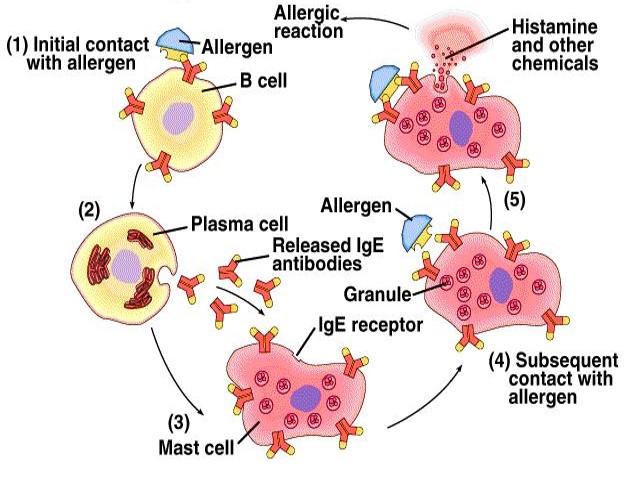
Diagram of the IgE-mediated allergic reaction, from initial contact with an allergen through to histamine release
How an allergic reaction develops: first contact sensitises the immune system, and later contact triggers IgE antibodies and the release of histamine.

About Allergens

Allergenic sensitivities vary from one person to another and it is possible to be allergic to an extraordinary range of substances. A common example of a genuine allergic reaction occurs when the body creates Immunoglobulin E or IgE antibodies after the person has consumed the food. When these IgE antibodies react with the food, histamine and other chemicals called “mediators” can cause hives, asthma, or other common symptoms of an allergic reaction. In its most severe form, an allergic reaction is classed as anaphylaxis, which is a sudden, severe, and potentially fatal allergic reaction that can involve several body systems. The first-line emergency treatment for anaphylaxis is the prompt administration of adrenaline (epinephrine), commonly by auto-injector, followed by emergency medical care. Anyone experiencing anaphylaxis must be taken to a medical facility without delay, even if symptoms appear to improve.

An allergy is the reaction of the immune system to a normally harmless substance. This occurs when the body mistakenly believes that consumed/ingested food is harmful, and creates specific antibodies to attack the substance. The next time the individual eats that particular food, the immune system releases massive amounts of chemicals including histamines which are intended to protect the body against the substance. These chemicals can cause a variety of allergic symptoms that can affect the respiratory system, gastrointestinal tract, skin, or cardiovascular system.

Food Intolerance

Food intolerance is an adverse food-induced reaction that does not involve the immune system. True food allergies include activation of the immune system. An example of food intolerance is lactose intolerance, which is usually when a person does not have any or enough of the enzyme required to digest milk or milk products. If a lactose intolerant person consumes milk or milk products, they might suffer from bloating and abdominal pain, but there is no production of any chemicals related to the immune system within the body.

Foods Commonly Associated with Allergies

A variety of foods contain ingredients that can cause adverse reactions in hypersensitive individuals. Most adverse food reactions are caused by the following foods and products made from them: peanuts; tree nuts including almonds, Brazil nuts, cashews, hazelnuts, macadamia nuts, pecans, pine nuts, pistachios, and walnuts; sesame seeds; milk; egg; fish; crustacea (crustaceans) including crab, crayfish, lobster, and prawns; molluscs (shellfish) including clams, mussels, oysters and scallops; soy; cereals containing gluten, including wheat, rye, barley, oats and spelt; lupin; and sulphites (sulfites) at concentrations of 10 mg/kg or 10 mg/L or more. Products containing even small amounts of the allergens listed above must be identified with appropriate labelling to ensure allergen sufferers can avoid relevant foods.

The list of allergens that must be declared varies between jurisdictions (for example the European Union, the United Kingdom, the United States, Canada, Australia and New Zealand). The requirements of every country in which a food is sold should be confirmed.

Other foods such as Pumpkin, Celery, Celeriac, Corn, Maize, Legumes are also often found to be food allergens.

Common hidden sources of allergens in foods include:

A pile of peanuts
Peanuts are a common cause of severe allergic reactions and a frequent hidden ingredient.

Peanuts

  • Peanut oil is sometimes used as an ingredient or a processing aid (the labelling status of refined peanut oil differs between jurisdictions, so confirm the requirements of your market);
  • Asian foods may contain peanuts in the form of oil, pastes, sauces, or garnish;
  • Crushed Nuts which are commonly used within baked goods and desserts may contain peanuts;
  • Producers, processors, and packers of other nuts may use the same equipment for peanuts;
  • Some breakfast cereals may contain peanuts.
A close-up of shelled walnuts
Walnuts and other tree nuts are controlled as a distinct allergen group.

Tree Nuts

  • Some manufactured meat products may contain tree nuts, for example, pistachio nuts in Mortadella;
  • Dessert items may contain tree nuts or traces of tree nuts;
  • Baked goods such as crackers and cereals may contain tree nuts;
  • Some breakfast cereals may contain tree nuts.
Sesame seeds in a small bowl
Sesame seeds are used whole, ground, and as oil or paste, including tahini.

Sesame Seeds

  • Some Asian and Middle Eastern foods may contain sesame seeds in the form of oil, pastes, sauces, or garnish;
  • Sesame is often used within sauces such as Tahini and Hummus.
A glass of milk on a white table
Milk and milk-derived ingredients such as casein appear in many processed foods.

Milk

  • Casein, a milk protein is often used in processed fish, meat, and non-dairy products;
  • Butter and cream are often found within ready-to-eat prepared foods from restaurants and cafes;
  • Meat slicing equipment is often used to slice meats, dairy products, and other items.
A brown egg resting in a nest
Egg and egg-derived ingredients are used as binders, glazes, and emulsifiers.

Eggs

  • Egg albumen protein may be used as a processing aid, in both dried and wet forms;
  • Egg lecithin emulsifier may be used as an agent in processed items;
  • Whole or parts of eggs may be used in dressings such as mayonnaise;
  • Some kinds of pasta and pasta products may contain eggs, both within the pasta, and fillings.
  • The equipment used to make egg-free pasta may also be used to produce pasta that contains egg.
A pile of raw prawns
Prawns are crustacea. Fish, crustacea, and molluscs are separate allergen groups.

Fish, Crustacea and Molluscs

  • Ethnic dishes from regions such as the Mediterranean, Northern Africa, and Asia often contain fish, crustacea (crustaceans), and molluscs (shellfish). This includes fish content within sauces and ingredients such as fish sauce, oyster sauce, dried anchovies, whole anchovies, and other dried fish, crustacea, and mollusc varieties;
  • Fish, crustacean, or mollusc (shellfish) stock may be used in prepared foods, both within foods and sauces;
  • Traditional Worcestershire sauce contains anchovies;
  • Omega 3 is commonly sourced from fish.
A block of tofu topped with sliced green onion
Soy is found in products such as tofu, sauces, and many processed foods.

Soy

  • Soy and soy products are often used as processing additives within fish, meat, dairy and non-dairy products;
  • Soy oil is sometimes used as an ingredient, processing aid, or lubricant (the labelling status of highly refined soy oil differs between jurisdictions, so confirm the requirements of your market);
  • Asian foods may contain soy and soy products in the form of oil, pastes, sauces, or garnish;
  • Soy products such as tofu in fresh, fried, paste, dried, or marinated forms may be used in some Asian foods;
  • Derivatives of Soy are often used in food processing for their functional effects on processed or manufactured foods.
A field of ripening wheat
Wheat is one of several cereals containing gluten.

Wheat and Other Cereals Containing Gluten

  • Wheat products are often used as functional additives within fish, meat, dairy, and other products;
  • Wheat-derived glucose syrups and maltodextrins may contain traces of gluten depending on the degree of refining, and their labelling status varies between jurisdictions;
  • Barley, rye, oats and spelt also contain gluten or gluten-like proteins and are declarable as cereals containing gluten in many jurisdictions;
Assortment of dried fruits displayed at a market
Dried fruits are a common source of sulphites (sulfites) used as a preservative.

Sulphites (Sulfites)

  • Sulphites (US spelling: sulfites) are given many different names including Sulphur Dioxide, Sodium Sulphite, Sodium Bisulphite, Sodium Meta-bisulphite, Potassium Bi-sulphite, and Potassium Meta-bisulphite;
  • Sulphites are commonly used as a preservative in many food products and beverages, and in many jurisdictions must be declared where present at 10 mg/kg or 10 mg/L or more.
A bunch of celery on a dark tray
Celery stalks, leaves, and seeds are declarable allergens in many regions.

Celery and Celeriac

  • Celery may be found within many different types of ethnic cuisines;
  • Celery seeds may be used within savoury flavourings such as compound seasonings;
  • Celery is often used in beverages such as the popular ‘Bloody Mary’;
  • Dehydrated Celery may be present within processed foods;
  • Celeriac, also called turnip-rooted celery, celery root, or knob celery is commonly used for a puree for modern restaurant dishes;
  • Celery or Celeriac leaves or shoots may be found within leafy salad mixes.
Green coconuts hanging from a palm tree
Coconut is used as water, milk, cream, oil, and sugar in many foods.

Coconut

  • Various types of Coconut products include Coconut Water, Coconut Milk, Coconut Cream, Coconut Oil, Coconut Milk Powder, and Coconut Sugar;
  • Coconut may be found within confectionery or baked products;
  • Many different ethnic cuisines contain various forms of Coconut products;
  • Coconut may be present within dairy products such as yogurt and ice cream;
  • Coconut Sugar may be used as a sweetener.
A pile of garlic bulbs
Garlic and onion may be present fresh, dried, or in sauces and seasonings.

Garlic and Onion

  • Garlic and Onion may be present in many forms, including fresh, dried, freeze-dried, whole, cut, minced, or fermented;
  • Many different regional cuisines contain various forms of Garlic and Onion products;
  • Garlic and Onion may be infused into liquids such as oil;
  • Salad dressings and sauces may contain Garlic and Onion.
A field of purple lupin flowers
Lupin plants in flower. Lupin flour and seed are used in some bakery and processed foods.

Lupin

  • Processed Foods, Health Food, Nutritional Supplements, and Bakery items may contain Lupins;
  • Bakery pre-mixes and some processed Crumb Products may include Lupin;
  • Lupin flour or ground Lupins may be used within items such as pastries, pies, pancakes, pizza, and pasta;
  • Batter-coated food products may contain Lupin.
A field of yellow mustard-family flowers under a clear sky
Mustard seed, from the flowering mustard plant, is used in condiments, dressings, and spice mixes.

Mustard

  • Mustard is commonly used as an ingredient within many savoury foods;
  • Salad dressings, sauces, pickles, and relishes may contain Mustard;
  • Regional foods may include Mustard Seeds or Mustard Flour as an ingredient;
  • Processed and unprocessed meat products may be flavoured with Mustard.
A person preparing dough beside a rolling pin
Yeast is used in bread and bakery items as well as brewed and fermented foods.

Yeast

  • Yeast and Yeast Extract may be found within many different food products;
  • Health foods and supplements may contain Yeast;
  • Many different Bakery items contain Yeast;
  • Brewed and Fermented Items may contain Yeast;
  • Over-ripe Fruit or Vegetables may contain elevated levels of Yeast.

Allergen Sufferers

Consumers with food allergies are generally advised to contact the manufacturer of a particular product, and in the case of restaurant meals, to enquire about the ingredients used before consumption. If allergen sufferers are in doubt about a certain food, it is best to avoid it totally, rather than risking an allergic reaction, and to seek advice from a medical practitioner or qualified allergy specialist.

Ripe kiwifruit stacked together
Fresh fruit such as kiwifruit is a common trigger of oral allergy syndrome.

Oral Allergy Syndrome

Most oral allergy reactions are caused by raw fruits, vegetables and nuts, because the proteins involved are often heat-labile and may be altered by cooking. Some foods, including celery and nuts, can still cause reactions after cooking. Some plant parts, such as the skin, may be more allergenic than others; the allergic characteristics of some fruits appear to decrease during storage. Foods associated with the oral allergy syndrome, which has occasionally been reported to cause anaphylactic reactions, include kiwifruit, hazelnut, white potato, celery, parsley, beans, and cumin.

Some individuals with oral allergy syndrome tolerate certain foods when they are well cooked or processed, but this cannot be assumed and varies between individuals. People who develop a rash, itching, or swelling when touching or peeling these foods may prevent this by wearing gloves. Consultation with a qualified allergen specialist is recommended to determine the cause of reactions to plant foods, and whether any special precautions are advisable.

Oral allergy syndrome is an allergic reaction to certain proteins in a variety of fruits, vegetables, and nuts, which develops in some people with pollen allergies. It is referred to as an oral allergy syndrome because it usually affects the mouth and throat.

Oral allergy syndrome is nearly always preceded by hay fever and tends to occur most often in older children and adults. It is usually associated with pollen allergies but it can also affect people with allergies to the pollens of grass, and other plants. These reactions can occur at any time of year but are often worse during the pollen season.

Symptoms may include itching and burning of the lips, mouth, and throat, watery itchy eyes, runny nose, and sneezing. Some individuals report that peeling or touching the offending foods may result in a rash, itching, or swelling where the juice touches the skin. More serious reactions can include hives and swelling of the mouth, pharynx, and windpipe. In rare cases, severe allergic reactions have been reported such as vomiting and diarrhoea, bronchial asthma, generalised hives, and anaphylactic shock. Symptoms usually develop within minutes of consuming or touching the food, but occasionally occur more than an hour later. A variety of fruits, vegetables, and their juices, including orange, tomato, apple, and grape, sometimes cause skin rashes and diarrhoea, especially in young children. Strawberries and pineapple can occasionally cause hives.

Control of Allergens Within a Food Business

Various processes and controls may be put in place to manage allergens on-site and prevent food that should not contain certain allergens from containing them.

These may include:

  • Control of allergens on-site through purchasing. This may include obtaining raw material specifications before purchasing products to assess, and restrict, if necessary, the allergens within each required raw material;
  • Control of processes such as re-working, which may potentially contaminate non-allergen products with allergenic ingredients. It is common for policies and procedures to be developed, documented, and implemented to ensure that only “like for like” products are reworked into each other, or alternately, for a matrix of reworkable products to be made available for production scheduling and operational teams;
  • Considering the purchase of synthetic flavourings and functional raw materials if the requirement is to restrict or eliminate certain allergens from the food business site. For example, a synthetic flavouring that is not derived from an allergenic source, or a glaze for baked products that does not contain egg, may be used.
  • Identification and storage of allergens in designated areas, including grouping similar allergens where possible;
  • Storage of allergenic material on lower shelving/racking to prevent spills onto non-allergenic materials;
  • Where possible, segregating preparation and processing areas, manufacturing or packaging lines for allergenic and non-allergenic foods;
  • If the same preparation and processing areas, manufacturing, or packaging lines have to be used for processing, consider the scheduling of non-allergenic products before processing allergenic products. Allergen scheduling is one of the most prominent methods for controlling allergen cross contacts within food businesses that produce both allergen-containing and non-allergen products;
  • Use of dedicated equipment for processing and cleaning of allergenic materials in case of spillage;
  • Specified allergen cleans between batches of allergenic and non-allergenic products. The verification of “allergen” cleaning activities between batches of products is commonly verified through the use of rapid testing methods that detect the presence of proteins on the surfaces cleaned;
  • Training of staff in basic Allergen Management and ensuring all possible measures are taken to prevent allergen cross-contact. For example, glove changing, hand washing, uniform control, utensil washing, staff site movements, and movement of allergen handling equipment should be considered within targeted Allergen Management training.

Allergen Labelling

If your food business supplies foodstuffs manufactured to a customer’s specifications, it is important to consider any specific Allergen Management Development requirements in relation to their items.

Undeclared ingredients on food labels may occur because of production and packaging instances such as “carry-over” or “hang-ups” of product or work in progress within production and packaging systems. This may occur due to incomplete cleaning of surfaces and utensils, an incorrect or incomplete listing of ingredients, or unknown ingredients in raw materials. Precautionary allergen labelling must be accurate and adequate, and must never take the place of good manufacturing practices, effective cleaning and allergen controls. Requirements for precautionary allergen labelling vary between jurisdictions. Some regions have no mandatory rules, and industry guidance such as the VITAL program is often used to support risk-based decisions.

In instances where precautionary or advisory allergen labelling is applied, it is important to consider that sales of the product may be affected by “over declaring” the potential for a product to contain an allergen that is not an ingredient. A structured risk-based methodology should be applied and documented to display the outcomes of such risk assessments.

It is important to consider any legislative requirements for the labelling of allergens within any food product. This is particularly important where foods contain ingredients that are pre-formulated and are added.

A scientist using a pipette with test tubes in a laboratory
Laboratory testing can verify allergen controls and cleaning effectiveness.

Analytical Testing for Allergen Management

To verify that the systems implemented for Allergen Management are effective, allergen-specific analysis can be carried out by a laboratory. This may be relevant to the product, process, or a combination of both. Product allergen testing is commonly scheduled, conducted, and recorded to confirm the inclusion or exclusion of specified allergens. Process allergen testing is commonly scheduled, conducted, and recorded to confirm the effectiveness of cleaning and sanitation in removing allergens. A variety of “rapid” test kits are available to assist with process verification for Allergen Management. Allergen test methods, whether “rapid” test kits or laboratory analytical methods, should be validated and fit for the allergen, the food matrix, and the level of detection required. Results from protein-based swabs and rapid kits indicate the presence of protein and are not always quantitative or allergen-specific, so it is important to ensure the method applied is appropriate for the outcome anticipated. Technical specialists should be consulted when selecting and confirming allergen testing methods.

Allergen “Free” Claims

Where Allergen “Free” Claims are made within product specifications or packaging, it is important that scheduled testing be conducted and recorded to verify such claims. It is generally considered best practice for Allergen-Free Claims to be confirmed on an ongoing basis against recognised testing methods, to ensure regulatory and consumer confidence. Claims such as “gluten free” have defined legal criteria that vary by country, and must be verified against the requirements of each market in which the product is sold.

If your food business supplies foodstuffs manufactured to a customer’s specifications, it is important to consider any specific Allergen Management Verification requirements in relation to their items.

You may wish to visit the Verification Activities section of haccp.com for examples of best practice applications for this food safety and quality system element.

Allergen Management Development Key Points

  • Allergen Management programs must be developed to meet relevant Regulatory, Industry, and Customer standards and requirements;
  • The Senior Management of your business facilitate a commitment to ensuring adequate resources to the development of your Allergen Management program;
  • Should you require additional resources for the development of Allergen Management program elements, please discuss this with the relevant Senior Management representative;
  • A properly developed Allergen Management program will provide a strong framework for your business to maintain compliance with relevant Regulatory, Industry, and Customer standards and requirements;
  • A poorly-developed Allergen Management program will not fully support your business and may contribute to significant non-compliance against Regulatory, Industry, and Customer standards and requirements.

To establish the developed detail in a viewable format to facilitate information.

Documentation

Document: A document provides guidance and or direction for performing work, making decisions, or rendering judgments that affect the safety or quality of the products or services that customers receive.

Documented policies, procedures, work instructions, and schedules form the basis of any food safety and quality management system. The following documentation formats may be considered to ensure ongoing compliance with specified requirements for Allergen Management:

  • Allergen Management policy;
  • Allergen Management development procedures;
  • Allergen Management monitoring procedures;
  • Allergen Management corrective and preventative action procedures;
  • Allergen Management verification schedule;
  • Allergen Management verification procedures;
  • Allergen Management validation schedule;
  • Allergen Management validation procedures;
  • Allergen Management training procedures.

If your food business supplies foodstuffs manufactured to a customer’s specifications, it is important to consider any specific Allergen Management Documentation requirements in relation to their items.

You may wish to visit the Allergen Management Templates section of haccp.com for examples of Allergen Management documentation, record, and resource formats commonly applied within food safety and quality systems.

Allergen Management Documentation Key Points

  • Allergen Management programs must be documented to meet relevant Regulatory, Industry, and Customer standards and requirements;
  • All documented Allergen Management program elements must be controlled to ensure compliance;
  • Key documented Allergen Management program elements should be available to your business team at all times to ensure they can facilitate required tasks;
  • A properly documented Allergen Management program will provide a strong framework for your business to maintain compliance with relevant Regulatory, Industry, and Customer standards and requirements;
  • A poorly documented Allergen Management program will not fully support your business and may contribute to significant non-compliance against Regulatory, Industry, and Customer standards and requirements.

To facilitate the application of the documentation.
Implementation

Implementation: Implementation is the application of documented food safety and quality system elements into the actual business operation.

The implementation of Allergen Management within any food business requires genuine commitment from senior management, staff, and visitors to ensure the nominated goals of implementation are achievable on an ongoing basis. It is a step that requires significant planning and consideration of general and specific food business circumstances to ensure the outcomes of Allergen Management do not negatively impact the safety and quality of the food items dispatched from the business.

Implementation of Allergen Management must include a clear definition of responsibilities and authorities for all levels of participation by senior management, staff, and visitors to the site.

When implementing Allergen Management within food safety and quality system, you may wish to consider the following requirements before completion:

  • Communication and display of the Allergen Management policy;
  • Completion of Verification and Validation of Allergen Management development procedures;
  • Availability of Allergen Management implementation procedures and work instructions;
  • Availability of Allergen Management monitoring procedures and record templates (where applicable);
  • Availability of Allergen Management corrective and preventative action procedures and record templates (where applicable);
  • Availability of the Allergen Management verification schedule;
  • Availability of Allergen Management verification procedures;
  • Availability of the Allergen Management validation schedule;
  • Availability of Allergen Management validation procedures;
  • Completion of Allergen Management training procedures;
  • Completion of product design and development requirements related to Allergen Management;
  • Completion of process design and development requirements related to Allergen Management;
  • Completion of training for team members who have responsibilities and involvement within Allergen Management;
  • Completion of competency approval for team members who have responsibilities and involvement within Allergen Management.

If your food business supplies foodstuffs manufactured to a customer’s specifications, it is important to consider any specific Allergen Management Implementation requirements in relation to their items.

Allergen Management Implementation Key Points

  • Allergen Management programs must be Implemented to meet relevant Regulatory, Industry, and Customer standards and requirements;
  • Your Allergen Management program must be fully implemented as per relevant documented Policies, Procedures, and Work Instructions;
  • The implementation of Allergen Management requires a commitment to the provision of resources by the Senior Management of your business;
  • A properly implemented Allergen Management program will provide a strong framework for your business to maintain compliance with relevant Regulatory, Industry, and Customer standards and requirements;
  • A poorly implemented Allergen Management program will not fully support your business and may contribute to significant non-compliance against Regulatory, Industry, and Customer standards and requirements.

To review, confirm and document evidence of the implementation against documented limits.

Monitor

Monitoring: Monitoring is the act of reviewing and confirming measurable parameters of a defined process or product status.

Monitoring requirements within food industry sectors are generally identified against limits of acceptability defined within HACCP plans, implementation procedures, and work instructions. Monitoring usually includes some element of record-keeping, which may be maintained manually or through digital systems. It is important to consider that advancements in technology have spawned many systems and processes which are self-monitored and/or self-adjusted when variances are identified. Regardless of the system used, the goal of any monitoring activity is to provide sufficient evidence that any limit of acceptability has been met.

Common Allergen Management monitoring requirements include manual recording and the application of corrective actions when the results of monitoring are found to be outside acceptable limits. Corrective Actions should also generally be strongly linked to the monitoring process where applied to ensure full traceability of the applied actions.

The following examples of monitoring activities and record formats may be applicable to Allergen Management:

  • Allergen Matrix: A listing of products manufactured including raw materials and allergen present in each, other products manufactured on the same line and their allergens;
  • Purchasing Records: Procedures for purchasing should reference the use of approved suppliers of specified raw materials to ensure no unidentified allergens enter foodstuffs;
  • Approved Supplier Program Confirmations: It is common for receival procedures to include the confirmation that received materials are from approved suppliers;
  • Specification Confirmations: It is common for receival procedures to include confirmation of received materials to agreed finished product or raw material specifications. Some received materials must be accompanied by a certificate of analysis to confirm allergenic or non-allergenic content of the finished product or raw materials received;
  • Pre-operational Inspection Records: These are often scheduled, conducted, and recorded to confirm that the cleaning and sanitation, premises and equipment and GMP supports to Allergen Management have been completed as specified. Allergen “swabs” or other activities such as ATP Bioluminescence swabbing is often used as a “real-time” verification method within Pre-operational Inspections;
  • Processing Records: Formats of processing records are often inclusive of step-by-step sign-off by operators on lines where Allergen Management is important to the safety and suitability of finished foodstuffs. Interactions may include a sign-off process for the handling and use of allergenic materials to ensure they have been used as specified;
  • Packaging Records: The format of packaging records is commonly inclusive of confirmations of product labelling compliance and “between product” changeovers and cleaning requirements where applicable;
  • GMP Inspection Records: Elements of GMP Inspections are often inclusive of confirmations of Allergen Management including storage, identification, handling, use, process control, packaging, and labelling.

If your food business supplies foodstuffs manufactured to a customer’s specifications, it is important to consider any specific Allergen Management Monitoring requirements in relation to their items.

You may wish to visit the Allergen Management Templates section of haccp.com for examples of Allergen Management documentation, record, and resource formats commonly applied within food safety and quality systems.

Allergen Management Monitoring Key Points

  • Monitoring provides real-time confirmation and evidence that your risk-based FS&Q Controls are effectively implemented;
  • Allergen Management programs must be monitored to meet relevant Regulatory, Industry, and Customer standards and requirements;
  • Monitoring of Allergen Management must be facilitated as per relevant documented Policies, Procedures and Work Instructions;
  • Nominated monitoring records for Allergen Management must be maintained as per relevant documented Policies, Procedures, and Work Instructions;
  • A properly monitored Allergen Management program will provide a strong framework for your business to maintain compliance with relevant Regulatory, Industry, and Customer standards and requirements;
  • A poorly monitored Allergen Management program will not fully support your business and may contribute to significant non-compliance against Regulatory, Industry, and Customer standards and requirements.

To apply “real time” interventions to documented monitoring limits.

Corrective Action

Corrective Action: Corrective action is mandatory action to be taken when a deviation to the Quality System occurs, particularly in relation to a Critical Control Point.

Preventative Action: At any step in the process where a hazard has been identified, preventative action must be put into place to prevent re-occurrence.

Corrective Action and Preventative Action are implemented to ensure identified non-conformances are documented, investigated, and rectified within appropriate timeframes.

Corrective action is any action applied to regain control over a product, process, policy, or procedure that has been identified as being non-conforming or outside nominated limits of acceptability.

Preventative action is any action applied to prevent any identified non-conformance from reoccurring.

The outcomes of corrective and preventative actions should result in regained process control after effective application. Specified corrective actions are commonly linked to the HACCP Plans and the food business certification process.

Below are Corrective Action and Preventative Action examples which may be associated with Allergen Management related non-conformances:

  • Review of the Allergen Management policy;
  • Review of Allergen Management development procedures;
  • Review of Allergen Management implementation procedures and work instructions;
  • Review of Allergen Management monitoring procedures;
  • Review of Allergen Management corrective and preventative action procedures;
  • Review of the Allergen Management verification schedule;
  • Review of Allergen Management verification procedures;
  • Review of the Allergen Management validation schedule;
  • Review of Allergen Management validation procedures;
  • Review of Allergen Management training procedures;
  • Re-training in Allergen Management;
  • Review of management review activities to include Allergen Management as an agenda item;
  • Initiation of “product hold” procedures where safety or quality may be compromised;
  • Initiation of a product recall or product recall procedures where investigations show that there is a substantial safety and or quality risk to the released product;
  • Contacting stakeholders including customers regarding any confirmed or potential Allergen Management concerns involving their product.

If your food business supplies foodstuffs manufactured to a customer’s specifications, it is important to consider any specific Allergen Management Corrective Action requirements in relation to their items.

You may wish to visit the Corrective Action and Preventative Action section of haccp.com for examples of best practice applications for this food safety and quality system element.

Allergen Management Corrective Action and Preventative Action Key Points

  • The implementation of Corrective Action and Preventative Action provides confidence that your FS&Q Program is effectively implemented and that FS&Q criteria are being met;
  • Where deviations or variations are observed, Corrective Action and Preventative Actions must be facilitated to meet relevant Regulatory, Industry, and Customer standards and requirements;
  • Corrective Action and Preventative Action of Allergen Management must be facilitated as per relevant documented Policies, Procedures and Work Instructions;
  • Records of Corrective Action and Preventative Action must for Allergen Management be maintained as per relevant documented Policies, Procedures and Work Instructions;
  • Proper application of Corrective Action and Preventative Action for your Allergen Management program will provide a strong framework for your business to maintain compliance with relevant Regulatory, Industry, and Customer standards and requirements;
  • Poor application of Corrective Action and Preventative Action for your Allergen Management program will not fully support your business and may contribute to significant non-compliance against Regulatory, Industry, and Customer standards and requirements.

To review and confirm documented monitoring and corrective actions against documented parameters.

Verify

Verification: The act of reviewing, inspecting, testing, checking, auditing, or otherwise establishing and documenting whether items, processes, services, or documents conform to specified requirements.

Verification is the detailed review of all food safety and quality system elements to confirm that they are effectively developed, documented, implemented, monitored, and reviewed. All food safety and quality system elements, including documented policies, procedures, training, HACCP plans, and operational applications must be verified on an ongoing scheduled basis. The verification process commonly includes a defined schedule for which verification activities are required, how often they are conducted, who is responsible, and detailed documented procedures for each nominated verification activity.

The general goal of an established verification process is to ensure any systemic non-conformances are identified and rectified within an appropriate timeframe. When non-conformances are identified through the verification process, Corrective Actions and Preventative Actions should be implemented to ensure they do not impact the effectiveness of the food safety and quality system.

The following examples of verification activities may be applicable to Allergen Management:

  • Review of the Allergen Management policy;
  • Review of Allergen Management development procedures;
  • Review of Allergen Management implementation procedures and work instructions;
  • Review of Allergen Management monitoring procedures;
  • Review of Allergen Management monitoring records;
  • Review of Allergen Management corrective and preventative action procedures;
  • Review of the Allergen Management verification schedule;
  • Review of Allergen Management verification procedures;
  • Review of the Allergen Management validation schedule;
  • Review of Allergen Management validation procedures;
  • Review of Allergen Management training procedures;
  • Review of Allergen Management performance since the last review and historically;
  • Analytical testing of product or process to ensure the effectiveness of Allergen Management;
  • Pre-operational Inspections to confirm the effectiveness of Allergen Management Procedures;
  • GMP Inspections to confirm the application of Allergen Management including storage, identification, handling, use, process control, packaging, and labelling;
  • Inclusion of Allergen Management as an agenda item within the Management Review Process.

Additional guidance is provided in the Analytical Testing for Allergen Management and Allergen “Free” Claims sections earlier on this page.

Allergen Management Verification Key Points

  • Your verification program provides evidence that your FS&Q Controls have worked;
  • Allergen Management programs must be verified to meet relevant Regulatory, Industry, and Customer standards and requirements;
  • The verification of Allergen Management must be facilitated as per relevant documented Policies, Procedures, and Work Instructions;
  • Nominated verification records for Allergen Management must be maintained as per relevant documented Policies, Procedures, and Work Instructions;
  • A properly verified Allergen Management program will provide a strong framework for your business to maintain compliance with relevant Regulatory, Industry, and Customer standards and requirements;
  • A poorly verified Allergen Management program will not fully support your business and may contribute to significant non-compliance against Regulatory, Industry, and Customer standards and requirements.

To confirm the documented monitoring or procedural limits.

Validate

Validation: The process of gathering evidence to provide a scientific basis for the documented act of demonstrating that a procedure, process, and activity will consistently lead to the expected results. It often includes the qualification of systems and equipment.

Validation is the provision of evidence to support the limits of control or acceptability for food safety or quality parameters nominated within systemic elements. Limits of control or acceptability are commonly included within documented food safety and quality systems elements such as procedures, HACCP plans, and specifications.

Common sources of validation include regulatory and legislative standards, finished product specifications and customer requirements, industry codes of practice and guidelines, verified and validated research, historical product, and process control outcomes, and analytical testing.

The general goal of an established validation process is to ensure any inappropriate limits of control or acceptability are identified and rectified within an appropriate timeframe. When non-conformances are identified through the validation process, Corrective Actions and Preventative Actions should be implemented to ensure they do not impact the effectiveness of the food safety and quality system.

Validation activities are commonly defined within the verification schedules and procedures of established food safety and quality management systems.

The following examples may apply to the validation of the limits of control or acceptability for Allergen Management:

  • Confirmation of nominated food safety and food quality control limits for Allergen Management. These limits may be applicable to regulatory, industry, customer, or finished product specifications;
  • Confirmation of analytical testing methods being used to confirm the effectiveness of Allergen Management and ensure the accuracy of outcomes.

If your food business supplies foodstuffs manufactured to a customer’s specifications, it is important to consider any specific Allergen Management Validation requirements in relation to their items.

You may wish to visit the Validation Activities section of haccp.com for examples of best practice applications for this food safety and quality system element.

Allergen Management Validation Key Points

  • Your validation program provides evidence that your FS&Q Controls will work;
  • Allergen Management programs must be validated to meet relevant Regulatory, Industry, and Customer standards and requirements;
  • The validation of Allergen Management must be facilitated as per relevant documented Policies, Procedures, and Work Instructions;
  • Nominated validation records and supporting documentation for Allergen Management must be maintained as per relevant documented Policies, Procedures and Work Instructions;
  • A properly validated Allergen Management program will provide a strong framework for your business to maintain compliance with relevant Regulatory, Industry, and Customer standards and requirements;
  • A poorly validated Allergen Management program will not fully support your business and may contribute to significant non-compliance against Regulatory, Industry, and Customer standards and requirements.

Skills, knowledge and competency requirements to facilitate development, documentation, implementation, monitoring, corrective action, verification and validation of every Food Safety and Quality System Element.

Skills and Knowledge

Skills and Knowledge: Skills and knowledge are attributes of human interactions commonly linked to competency within any specified job-related task.

Training and competency requirements for Allergen Management must be ongoing, including regularly scheduled reviews to ensure the effectiveness of training and competency outcomes.

Team members who have defined responsibilities regarding Allergen Management should have knowledge including:

  • Basic Allergen Management requirements;
  • Positive outcomes of Allergen Management;
  • Negative outcomes of a lack of Allergen Management;
  • Current Allergen Management procedures, methods, and techniques;
  • General operational, corporate, and social awareness regarding Allergen Management;
  • Regulatory, industry, and customer requirements regarding Allergen Management.

Team members who have defined responsibilities regarding Allergen Management should have skills including:

  • Competency regarding basic Allergen Management;
  • Effective application of current Allergen Management procedures, methods, and techniques;
  • The basic development, documentation, and implementation of HACCP and Pre-requisite Programs within the food industry sector.

Team members who have defined responsibilities regarding Allergen Management should have access to resources including:

  • Allergen Management training;
  • Allergen Management associations and events;
  • Regulatory standards, industry and customer information, and updates regarding Allergen Management;
  • Incidents within the food industry sector regarding Allergen Management;
  • Commitment to Allergen Management by senior management;
  • Suitably qualified food industry professionals with verified experience in Allergen Management;
  • Effective communication systems including email, internet, and phone through which Allergen Management information can be sent and received within suitable timeframes.

If your food business supplies foodstuffs manufactured to a customer’s specifications, it is important to consider any specific Allergen Management Training, Competency, and Resources requirements in relation to their items.

You may wish to visit the Training, Competency, and Resources section of haccp.com for examples of best practice applications for this food safety and quality system element.

Allergen Management Training, Skills, and Knowledge Key Points

  • Your Training, Skills, and Knowledge program ensures all participating personnel, visitors, and contracted have the required skills and knowledge to effectively facilitate the requirements of your FS&Q Program;
  • Training, Skills, and Knowledge programs for Allergen Management must be facilitated to meet relevant Regulatory, Industry, and Customer standards and requirements;
  • Training, Skills, and Knowledge programs for Allergen Management must be facilitated as per relevant documented Policies, Procedures, and Work Instructions;
  • Training, Skills, and Knowledge records for Allergen Management must be maintained as per relevant documented Policies, Procedures and Work Instructions;
  • Properly applied Training, Skills, and Knowledge programs for Allergen Management will provide a strong framework for your business to maintain compliance with relevant Regulatory, Industry, and Customer standards and requirements;
  • Poorly applied Training, Skills, and Knowledge programs for Allergen Management will not fully support your business and may contribute to significant non-compliance against Regulatory, Industry, and Customer standards and requirements.

Share this:

Facebook
Twitter
X
Email